
Categories
News Project

Outonomy book is out!

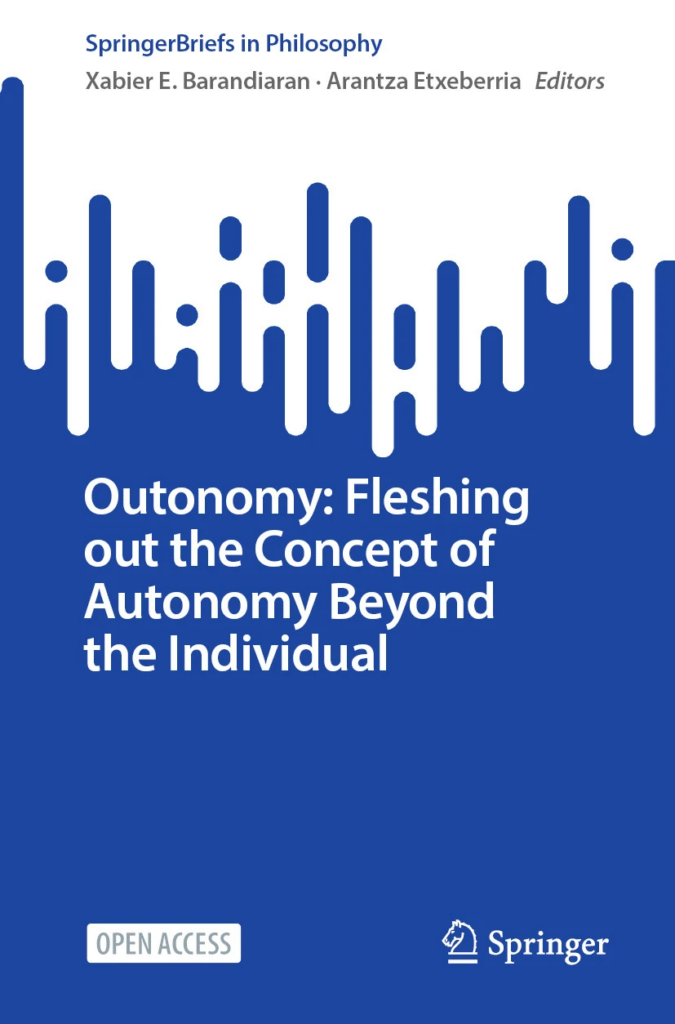
We’re excited to announce the publication of Outonomy: Fleshing out the Concept of Autonomy Beyond the Individual, edited by Xabier E. Barandiaran and Arantza Etxeberria, now available with Springer in the SpringerBriefs in Philosophy series. This book is the unified and integrated result of our research project. It gathers a rich, cross-disciplinary exploration of autonomy that moves beyond the classic, self-sufficient model of the individual. Instead, it develops the concept of outonomy to capture how autonomy is constituted through relations: with environments, other agents, technologies, institutions, and social-ecological systems.
Why “Outonomy”?

Autonomy has long been central to modern thought, ethics, and the life sciences. But many contemporary debates—across philosophy of biology, cognitive science, medicine, technology studies, and political theory—show that the boundaries of the autonomous subject are often porous and co-constructed. The outonomy framework responds to this situation by offering a more interactional and environmentally situated account of self-governance and normativity.

In the opening chapter, Barandiaran and Etxeberria outline 4 key properties that help articulate this shift:

Interactivity
Collectivity
Extensionality
Environmentality

Along two fundamental dimensions:

Integration
Sustainability

Together, these ideas reframe autonomy as something that emerges across scales of interaction and dependence, rather than something sealed within an isolated individual.

A structured journey across life, mind, technology, and politics

The volume is organized into four parts that build a coherent arc while engaging multiple domains:

Part I: Theoretical Insights
Foundational chapters clarify the conceptual stakes of outonomy and rethink control and organization in biological systems.

Part II: The Fabric of Life
Chapters address environments and asymmetries, the origins of life, reproduction, and a compelling application to menstrual health.

Part III: The Psychic Self and Its Environment
Here the outonomy perspective extends into psychiatry, salutogenesis, and pain, emphasizing embodied and relational normativity.

Part IV: Technology, Ecology & Politics
These chapters explore technocomplexity, the limits of autonomy in social-ecological systems, subjects-in-common, and mindshaping in relation to adaptive preferences.

A collaborative research effort

The book emerges from sustained work within the Outonomy research network and related projects, with authors actively reviewing and strengthening each other’s contributions. It also benefits from external reviewers who helped refine the final manuscript.

Open access

Importantly, this is an open access publication under a Creative Commons Attribution 4.0 license, making it freely available for reading, sharing, and scholarly use, both as an entire PDF file or by chapters.

Read the book on SpringerLink:
Outonomy: Fleshing out the Concept of Autonomy Beyond the Individual
(Available here: https://link.springer.com/book/10.1007/978-3-032-05501-9)


Categories
News Project

PhD Studentship opportunity

SUMMARY: Opportunity to join us at the IAS-Research Center for Life, Mind, and Society [https://ias-research.net] at the University of the Basque Country (San Sebastián) for a PhD studentship within the “Outagencies: Varieties of autonomous agency across living, humanimal, and technical systems” project [https://outonomy.net/project-description/]: an interdisciplinary exploration of agency across philosophy, biology, AI, and social sciences. We welcome passionate candidates from any background aligned with our research themes, who bring strong motivation, English proficiency, and a robust academic profile.
Deadline: November 18th, 2024
Pre-submission here: https://forms.gle/AGAHu6osrSUJ4Bxd9
Official submission here: https://www.ehu.eus/es/web/ikerketaren-kudeaketa/-/fpi-2024_upv_ehu
Salary: €19,500-€25,000 annually during 4 years (salary increases every year)
Duration: 4 years starting early 2025
More updated information: https://outonomy.net/?p=335

***

We’re thrilled to invite motivated researchers from around the world to apply for a unique PhD studentship at the University of the Basque Country (UPV/EHU), based in the IAS-Research Center for Life, Mind, and Society. This studentship is part of the research project “Outagencies: Varieties of autonomous agency across living, humanimal, and technical systems” (PID2023-147251NB-I00 lead by Xabier Barandiaran), where we explore the concept of “agency” across a range of disciplines—from philosophy to artificial intelligence, and from evolutionary biology to social sciences.

A Bit About Us and the Outagencies Project

Our centre [https://ias-research.net], located in the vibrant city of San Sebastián on the Basque coast, fosters a dynamic, interdisciplinary environment where more than 20 researchers from diverse backgrounds are investigating the philosophical, theoretical, and complex systems aspects of life, mind, and society. Our project [https://outonomy.net/project-description/], with its naturalistic and transdisciplinary approach, is an exciting inquiry into autonomous agency, aiming to bridge gaps across disciplines and uncover how agency manifests and interacts with materiality, technology, and living systems. It’s a great opportunity to join us if you’re interested in philosophical reflection that connects deeply with scientific and technological developments.

What We’re Looking For

We’re seeking candidates who are excited about our research focus and interested in contributing to the project’s work packages: from studying protocell organization and ecological contexts in “Living Matters,” to studying transitions along the animal-human continuum in “Humanimal Varieties”, to analyzing AI’s impact on human agency in “Artificial Agencies,” to integrating findings across philosophical perspectives in “Acts of Integration”. You can learn more about the project here:
https://outonomy.net/project-description/

Beyond formal requirements, we highly value applicants with a strong motivation for this project. We’ll assess candidates based on:

  • Your motivation letter, where we’d love to hear why this project resonates with you and which areas of our research you’re most passionate about.
  • The quality of an academic work sample (such as your Master’s thesis, class paper, or article).
  • Your language proficiency in English (certification required).
  • Other languages and your disciplinary background, especially if it aligns with the project focus.

While the administrative side of the application process is important, we encourage you to think of this as the beginning of a collaborative journey. We are excited to meet enthusiastic individuals who wish to dive into a challenging academic environment with like-minded peers.

Key Details & How to Apply

The successful candidate will begin work with us in early 2025 (before March), based on-site in San Sebastián, with an annual gross salary of €19,00-€26,000, non-negotiable, that increases every year.

If you want to apply, you will have to follow two parallel procedures:

1. Preliminary academic evaluation and submission process (mandatory before November 18th, 2024): Initial Application Form [https://forms.gle/AGAHu6osrSUJ4Bxd9]

2. Formal administrative application (required alongside the above) will be published here: Official Call [https://www.ehu.eus/es/web/ikerketaren-kudeaketa/-/fpi-2024_upv_ehu]

We understand this implies a double effort, but we believe this first step allows us to connect with you directly and evaluate your academic profile with care and understanding. 

Any queries about requirements, formal procedure and contracting-related questions, access, visas, or any other technical consultation should be addressed to  pre-postdoc.dgi@ehu.eus AND rrhh-inves.dgi@ehu.eus or by calling +34 946017865 or +34 946012046 where you can be assisted in English (as well as Spanish or Basque).

We look forward to receiving your application and hopefully welcoming you soon to the IAS-Research Center, where we’ll be delving together into some of the most fascinating philosophical questions of our times!

Categories
Project

How to acknowledge this project

Any activity, but most importantly PUBLICATIONS, of this OUTAGENCIES, project must include the following acknowledgement:

Grant PID2023-147251NB-I00 for project “OUTAGENCIES: Varieties of autonomous agency across living, humanimal and technical system” (PI Xabier Barandiaran) funded by MCIU/AEI/10.13039/501100011033 and FEDER/EU

In Spanish:

Ayuda PID2023-147251NB-I00 del proyecto “OUTAGENCIES: Varieties of autonomous agency across living, humanimal and technical system” (IP: Xabier Barandiaran) financiado por MICIU/AEI/10.13039/501100011033 y FEDER/UE

If, for any reason, you need to shorten the acknolwedgement you can skip the name of the project and the PI’s information and leave it as:

Grant PID2023-147251NB-I00 funded by MICIU/AEI/10.13039/501100011033 and by ERDF/EU

For further details and cases beyond simple papers (e.g. books, conference/workshop organization, posters, videos, etc.) please check out the full guide. But basically, you need to add the following logos to the text above for “libros, monografías, material audiovisual, congresos, conferencias, seminarios, folletos, placas
y carteles informativos, páginas web, equipamiento, otros”:

https://www.aei.gob.es/sites/default/files/inline-images/MICIU%2BCofinanciado%2BAEI.jpg

Categories
News Project

New project OUTAGENCIES

We are glad to announce that the Spanish Ministry of Science and Innovation has positively evaluated a new grant for our project “OUTAGENCIES: Varieties of autonomous agency across living, humanimal and technical systems” led by Xabier E. Barandiaran. You can know more about this project here.

Categories
Uncategorized

Gaia and Philosophy

International Symposium
1-3 December, Donostia – San Sebastián
Basque Country University (UPV/EHU)
Organised by IAS-Research – Outonomy project

Jean Michel Etchecolonea, CC BY-SA 3.0 via Wikimedia Commons / Cropped

→Registration form

Program

Updated 25/11/22

Thursday 1 December

16-18hIAS-Research Talk
Bruce Clarke: “Planetary intelligence: a Gaian critique”
follow online: https://meet.jit.si/IAS-ResearchSeminars
UPV/EHU Biblioteka Carlos Santamaría, Room 4
Pl. de Elhuyar, 2, Donostia – San Sebastián

Friday 2 December

10h00 – 10h45
 
Bruce Clarke presenting Writing Gaia: The Scientific Correspondence of James Lovelock and Lynn Margulis, Cambridge University Press, 2022.
Q&A
11h00 – 11h45Sébastien Dutreuil “Scientific hypothesis, research program, or philosophy of nature?” (online)
Q&A
12h-12h45Audronė Žukauskaitė “Gaia and Organism-Oriented Ontology”
Q&A
13hLunch
14h30-15h15Sergio Rubin “Taking the Gaia hypothesis at face value: From Earth organization and functional climatology to Gaian cognition”
Q&A
15h30-16h15Gillian Barker “Geofunctions: A pragmatic approach to functions, norms, and purposes at planetary scale” (online)
Q&A
16h30-17h00Debate and conclusions
Follow online through Webex
UPV/EHU, HEFA (Education, Philosophy and Anthropology) Faculty, Sala de Juntas.
Av. Tolosa 70, Donostia – San Sebastián.
19h Evening Lecture (external event)
“Gaian Being and the Anthropocene”
Bruce Clarke, presented by Arantza Etxeberria.
Koldo Mitxelena cultural centre, Urdaneta Kalea, 9, Donostia
With simultaneous interpretation to Castilian.

Saturday

10h30-13hGuided field trip with Asier Hilario, Scientific Director of the Basque Coast Unesco Global Geopark
“Life and climate evolution on Earth’s history as reflected in the Zumaia Flysch”
Meeting points:
9h30 Lugaritz station in Donosti / 10h30 Zumaia Turism Office
ElviraOliver, CC BY-SA 3.0 ES, via Wikimedia Commons / Cropped

Participants

Gillian Barker is Visiting Research Professor, Department of History and Philosophy of Science, University of Pittsburgh. Her recent research has focused on complex adaptive systems at different levels of organization, and how science can best grapple with their distinctive features in investigating human immunology, ecological and psychological resilience, evolutionary dynamics, and what evolved human nature can teach us about the prospects for social change. Her current research applies similar ideas to the problems of understanding and managing the interconnected global-scale processes upon which human societies depend: what I call “geo-functions.” This research connects recent developments in climate science, ecology, agricultural science, and hydrology, and involves extensive collaboration across academic disciplines and with non-academic expert practitioners.

Bruce Clarke is Paul Whitfield Horn Distinguished Professor of Literature and Science in the Department of English at Texas Tech University, and the 2019 Blumberg/NASA Chair in Astrobiology at the Library of Congress. His research focuses on systems theory, narrative theory, and ecology. He is the author of Gaian Systems: Lynn Margulis, Neocybernetics, and the End of the Anthropocene and co-editor of the forthcoming Writing Gaia: The Scientific Correspondence of James Lovelock and Lynn Margulis.

Sébastien Dutreuil is CNRS researcher at Centre Gilles Gaston Granger in Marseille. His PhD Thesis is “Gaïa : hypothèse, programme de recherche pour le système Terre, ou philosophie de la nature”. He has co-authored the paper “Life on Earth is hard to spot”, with Timothy M. Lenton and Bruno Latour, and is co-editor of the forthcoming Writing Gaia: The Scientific Correspondence of James Lovelock and Lynn Margulis.

Arantza Etxeberria is Associate Professor at the University of the Basque Country UPV/EHU, and a researcher at IAS Research Centre. Recently she was the co-PI on a Project on “Inter-identities: Ontological and normative aspects of biological, cognitive and social individuality”. She has written articles on conceptualizations of biological reproduction and pregnancy, on relational accounts of organisms and environments, and on the work on these topics by philosopher Georges Canguilhem. Her main research interests are on individuality and autonomy in biology and medicine, biological organization and its evolution from the perspective of evo devo, and classifications in science and society.

Asier Hilario is the Scientific director of the Basque Coast Geopark and Project Manager of GEO.5 Geological Heritage.

Sergio Rubin is researcher at the Georges Lemaître Centre for Earth and Climate Research, Earth and Life Institute of the Université catholique de Louvain, Belgium and member of the editorial board of Cybernetics & Human Knowing. A Journal of Second Order Cybernetics, Autopoiesis & Cybersemiotics. His interest revolves around the multiple theoretical-biological approaches to central problems of biology such as protein folding, synthetic biology, origin of life, exo-biology, and the Gaia hypothesis. Among other publications, he has written several papers on Gaia from an organizational second-order perspective inspired by relational biology and systemic biology of cognition, such as “Future climates: Markov blankets and active inference in the biosphere” with Karl Friston, “Taking the Gaia hypothesis at face value”, “Earth’s Complexity Is Non-Computable: The Limits of Scaling Laws, Nonlinearity and Chaos”, and “Beyond planetary-scale feedback self-regulation: Gaia as an autopoietic system”. 

Audronė Žukauskaitė is Chief Researcher at the Lithuanian Culture Research Institute. Her recent publications include the monographs Gilles Deleuze and Felix Guattari’s Philosophy: The Logic of Multiplicity (in Lithuanian, 2011), and From Biopolitics to Biophilosophy (in Lithuanian, 2016). She also co-edited (with S. E. Wilmer) Interrogating Antigone in Postmodern Philosophy and Criticism (2010); Deleuze and Beckett (Palgrave Macmillan, 2015), Resisting Biopolitics: Philosophical, Political and Performative Strategies (Routledge, 2016; 2018), and Life in the Posthuman Condition: Critical Responses to the Anthropocene (Edinburgh UP, 2023). Her latest monograph Organism-Oriented Ontology is forthcoming from Edinburgh University Press. Her research interests include contemporary philosophy, Deleuze and Guattari’s philosophy, biopolitics, biophilosophy, and posthumanism.

https://twitter.com/ehuHEFA/status/1596108866680504321
Categories
Workshops and Events

Program announcement

We are happy to finally share the program for the workshop! Check it out here.

Categories
Uncategorized

Deadline Extension

We have extended the deadline of the call for abstracts for the Outonomy workshop! You can now submit your abstracts through this form until the 15th of January, and find all the rest of the information here.

Categories
Workshops and Events

Call4Abstracts

The call for abstracts for the workshop is now open until the 15th of december.

You can read the call and fill the form to submit your proposal here.

Categories
Workshops and Events

Workshop dates: 22-24th June 2022

Make room in your agendas and update your calendar. We will be hosting the Outonomy Workshop 22-24th of June 2022! We are now planning to open a call4abstract and invitation to guest speakers.

Categories
Project

New site

This is the website that we just opened to coordinate the Outonomy project. You are welcome to join and follow our news, results and proposals.