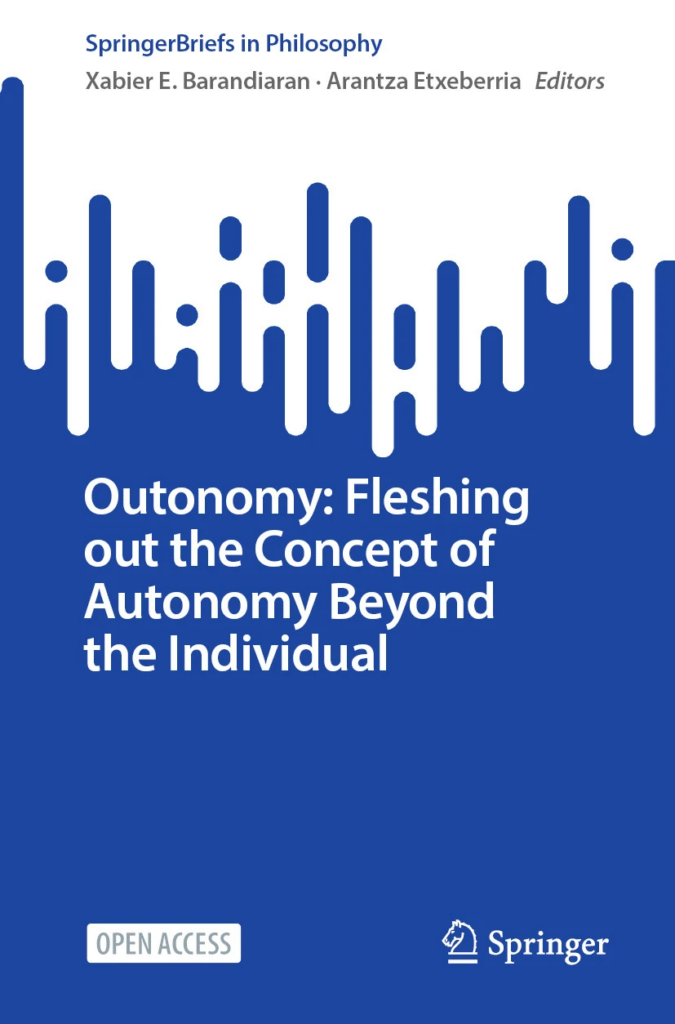
We’re excited to announce the publication of Outonomy: Fleshing out the Concept of Autonomy Beyond the Individual, edited by Xabier E. Barandiaran and Arantza Etxeberria, now available with Springer in the SpringerBriefs in Philosophy series. This book is the unified and integrated result of our research project. It gathers a rich, cross-disciplinary exploration of autonomy that moves beyond the classic, self-sufficient model of the individual. Instead, it develops the concept of outonomy to capture how autonomy is constituted through relations: with environments, other agents, technologies, institutions, and social-ecological systems.
Why “Outonomy”?
Autonomy has long been central to modern thought, ethics, and the life sciences. But many contemporary debates—across philosophy of biology, cognitive science, medicine, technology studies, and political theory—show that the boundaries of the autonomous subject are often porous and co-constructed. The outonomy framework responds to this situation by offering a more interactional and environmentally situated account of self-governance and normativity.
In the opening chapter, Barandiaran and Etxeberria outline 4 key properties that help articulate this shift:
Together, these ideas reframe autonomy as something that emerges across scales of interaction and dependence, rather than something sealed within an isolated individual.
A structured journey across life, mind, technology, and politics
The volume is organized into four parts that build a coherent arc while engaging multiple domains:
Part I: Theoretical Insights Foundational chapters clarify the conceptual stakes of outonomy and rethink control and organization in biological systems.
Part II: The Fabric of Life Chapters address environments and asymmetries, the origins of life, reproduction, and a compelling application to menstrual health.
Part III: The Psychic Self and Its Environment Here the outonomy perspective extends into psychiatry, salutogenesis, and pain, emphasizing embodied and relational normativity.
Part IV: Technology, Ecology & Politics These chapters explore technocomplexity, the limits of autonomy in social-ecological systems, subjects-in-common, and mindshaping in relation to adaptive preferences.
A collaborative research effort
The book emerges from sustained work within the Outonomy research network and related projects, with authors actively reviewing and strengthening each other’s contributions. It also benefits from external reviewers who helped refine the final manuscript.
Open access
Importantly, this is an open access publication under a Creative Commons Attribution 4.0 license, making it freely available for reading, sharing, and scholarly use, both as an entire PDF file or by chapters.
Guided field trip with Asier Hilario, Scientific Director of the Basque Coast Unesco Global Geopark “Life and climate evolution on Earth’s history as reflected in the Zumaia Flysch”
Meeting points: 9h30 Lugaritz station in Donosti / 10h30 Zumaia Turism Office
ElviraOliver, CC BY-SA 3.0 ES, via Wikimedia Commons / Cropped
Participants
Gillian Barker is Visiting Research Professor, Department of History and Philosophy of Science, University of Pittsburgh. Her recent research has focused on complex adaptive systems at different levels of organization, and how science can best grapple with their distinctive features in investigating human immunology, ecological and psychological resilience, evolutionary dynamics, and what evolved human nature can teach us about the prospects for social change. Her current research applies similar ideas to the problems of understanding and managing the interconnected global-scale processes upon which human societies depend: what I call “geo-functions.” This research connects recent developments in climate science, ecology, agricultural science, and hydrology, and involves extensive collaboration across academic disciplines and with non-academic expert practitioners.
Bruce Clarke is Paul Whitfield Horn Distinguished Professor of Literature and Science in the Department of English at Texas Tech University, and the 2019 Blumberg/NASA Chair in Astrobiology at the Library of Congress. His research focuses on systems theory, narrative theory, and ecology. He is the author of Gaian Systems: Lynn Margulis, Neocybernetics, and the End of the Anthropocene and co-editor of the forthcoming Writing Gaia: The Scientific Correspondence of James Lovelock and Lynn Margulis.
Sébastien Dutreuil is CNRS researcher at Centre Gilles Gaston Granger in Marseille. His PhD Thesis is “Gaïa : hypothèse, programme de recherche pour le système Terre, ou philosophie de la nature”. He has co-authored the paper “Life on Earth is hard to spot”, with Timothy M. Lenton and Bruno Latour, and is co-editor of the forthcoming Writing Gaia: The Scientific Correspondence of James Lovelock and Lynn Margulis.
Arantza Etxeberria is Associate Professor at the University of the Basque Country UPV/EHU, and a researcher at IAS Research Centre. Recently she was the co-PI on a Project on “Inter-identities: Ontological and normative aspects of biological, cognitive and social individuality”. She has written articles on conceptualizations of biological reproduction and pregnancy, on relational accounts of organisms and environments, and on the work on these topics by philosopher Georges Canguilhem. Her main research interests are on individuality and autonomy in biology and medicine, biological organization and its evolution from the perspective of evo devo, and classifications in science and society.
Asier Hilario is the Scientific director of the Basque Coast Geopark and Project Manager of GEO.5 Geological Heritage.
Sergio Rubin is researcher at the Georges Lemaître Centre for Earth and Climate Research, Earth and Life Institute of the Université catholique de Louvain, Belgium and member of the editorial board of Cybernetics & Human Knowing. A Journal of Second Order Cybernetics, Autopoiesis & Cybersemiotics. His interest revolves around the multiple theoretical-biological approaches to central problems of biology such as protein folding, synthetic biology, origin of life, exo-biology, and the Gaia hypothesis. Among other publications, he has written several papers on Gaia from an organizational second-order perspective inspired by relational biology and systemic biology of cognition, such as “Future climates: Markov blankets and active inference in the biosphere” with Karl Friston, “Taking the Gaia hypothesis at face value”, “Earth’s Complexity Is Non-Computable: The Limits of Scaling Laws, Nonlinearity and Chaos”, and “Beyond planetary-scale feedback self-regulation: Gaia as an autopoietic system”.
Audronė Žukauskaitė is Chief Researcher at the Lithuanian Culture Research Institute. Her recent publications include the monographs Gilles Deleuze and Felix Guattari’s Philosophy: The Logic of Multiplicity (in Lithuanian, 2011), and From Biopolitics to Biophilosophy (in Lithuanian, 2016). She also co-edited (with S. E. Wilmer) Interrogating Antigone in Postmodern Philosophy and Criticism (2010); Deleuze and Beckett (Palgrave Macmillan, 2015), Resisting Biopolitics: Philosophical, Political and Performative Strategies (Routledge, 2016; 2018), and Life in the Posthuman Condition: Critical Responses to the Anthropocene (Edinburgh UP, 2023). Her latest monograph Organism-Oriented Ontology is forthcoming from Edinburgh University Press. Her research interests include contemporary philosophy, Deleuze and Guattari’s philosophy, biopolitics, biophilosophy, and posthumanism.