
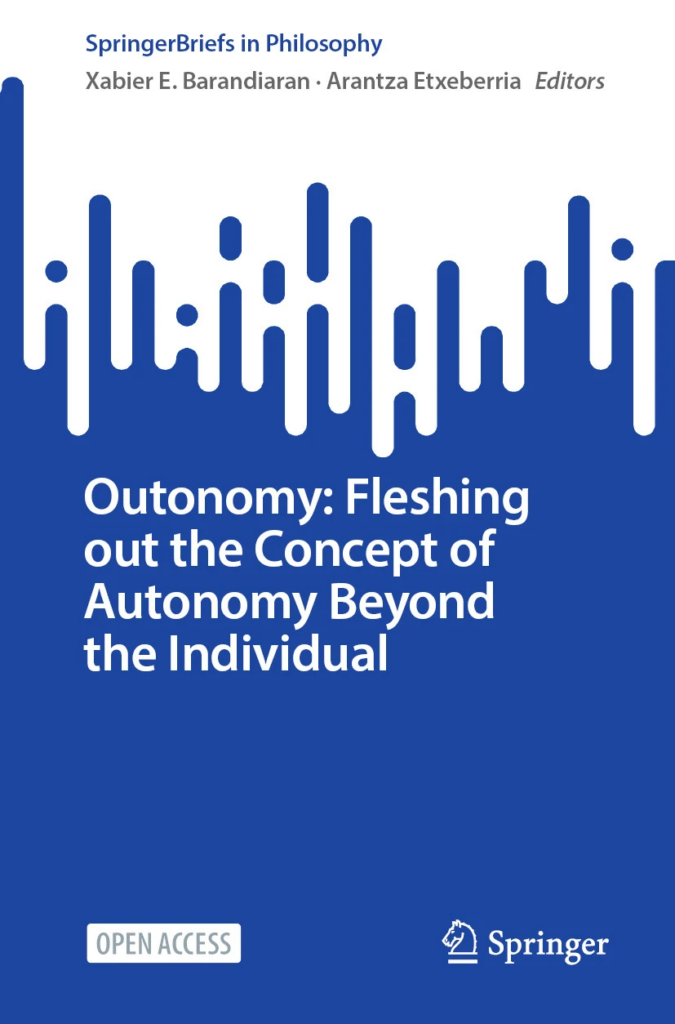
We’re excited to announce the publication of Outonomy: Fleshing out the Concept of Autonomy Beyond the Individual, edited by Xabier E. Barandiaran and Arantza Etxeberria, now available with Springer in the SpringerBriefs in Philosophy series. This book is the unified and integrated result of our research project. It gathers a rich, cross-disciplinary exploration of autonomy that moves beyond the classic, self-sufficient model of the individual. Instead, it develops the concept of outonomy to capture how autonomy is constituted through relations: with environments, other agents, technologies, institutions, and social-ecological systems.
Why “Outonomy”?
Autonomy has long been central to modern thought, ethics, and the life sciences. But many contemporary debates—across philosophy of biology, cognitive science, medicine, technology studies, and political theory—show that the boundaries of the autonomous subject are often porous and co-constructed. The outonomy framework responds to this situation by offering a more interactional and environmentally situated account of self-governance and normativity.
In the opening chapter, Barandiaran and Etxeberria outline 4 key properties that help articulate this shift:
Interactivity
Collectivity
Extensionality
Environmentality
Along two fundamental dimensions:
Integration
Sustainability
Together, these ideas reframe autonomy as something that emerges across scales of interaction and dependence, rather than something sealed within an isolated individual.
A structured journey across life, mind, technology, and politics
The volume is organized into four parts that build a coherent arc while engaging multiple domains:
Part I: Theoretical Insights
Foundational chapters clarify the conceptual stakes of outonomy and rethink control and organization in biological systems.
Part II: The Fabric of Life
Chapters address environments and asymmetries, the origins of life, reproduction, and a compelling application to menstrual health.
Part III: The Psychic Self and Its Environment
Here the outonomy perspective extends into psychiatry, salutogenesis, and pain, emphasizing embodied and relational normativity.
Part IV: Technology, Ecology & Politics
These chapters explore technocomplexity, the limits of autonomy in social-ecological systems, subjects-in-common, and mindshaping in relation to adaptive preferences.
A collaborative research effort
The book emerges from sustained work within the Outonomy research network and related projects, with authors actively reviewing and strengthening each other’s contributions. It also benefits from external reviewers who helped refine the final manuscript.
Open access
Importantly, this is an open access publication under a Creative Commons Attribution 4.0 license, making it freely available for reading, sharing, and scholarly use, both as an entire PDF file or by chapters.
Read the book on SpringerLink:
Outonomy: Fleshing out the Concept of Autonomy Beyond the Individual
(Available here: https://link.springer.com/book/10.1007/978-3-032-05501-9)
